مکانیک مهندسی سازه ها  Engineering Mechanics for Structures Dover Books on Engineering

Engineering Mechanics for Structures (Dover Books on Engineering)

[Image: 00501466910149159917.jpg]

[Image: info.png]
By Louis L. Bucciarelli

* Publisher: Dover Publications (March 13, 2009)
* Number Of Pages: 320
* ISBN-10 / ASIN: 0486468550
* ISBN-13 / EAN: 9780486468556

Product Description:
This text explores the mechanics of solids and statics as well as the strength of materials and elasticity theory. It features many design exercises that encourage creative initiative and systems thinking. Suitable for undergraduate and graduate students of civil engineering and engineering mechanics, it is also relevant to students of architecture. Reprint of the online edition, MIT, 2002.


[Image: Download.png]

 http://depositfiles.com/en/files/s4b425c8p


مطالبی از سازه را در این سایت ببینید....


مطالبی از سازه را در این سایت ببینید....


http://lowery.tamu.edu/cven345/Lectures/Lectures.htm

نرم افزار طراحی بیس پلیت (DesignStudio)

منبع : علمیران www.ElmIran.Net

نرم افزار طراحی بیس پلیت (DesignStudio)

در این تاپیک قصد داریم به معرفی یک برنامه ایرانی برای طراحی بیس پلیت بپردازیم

این نرم افزار با رویکرد جالب و کاربردی در حال گسترش می باشد و امیدواریم تولید کننده و توسعه دهنده این برنامه یعنی آقای “محمد خیرآبادی” در این راه موفق باشند.

این برنامه با دو نوع استاندارد ایران و AISC به طراحی می پردازد

از قابلیت های این برنامه ظاهر زیبا و کاربردی آن می باشد

از طرفی محیط برنامه دوزبانه طراحی شده. گرچه زبان فارسی آن قابل فهم تر می باشد !

کاربرانی که مایل به استفاده از این برنامه می باشند پس از آشنایی با برنامه می توانند تنها با پرداخت ۱۰ هزار تومن به نسخه نهایی و کامل لون دسترسی داشته باشند

بخش های دیگر این برنامه شامل طراحی تیرچه و اتصال فلزی تیر به ستون نیز از طرف توسعه دهنده در حال گسترش می باشد

امیدواریم در آینده نزدیک شاهد قابلیت های بیشتری در این برنامه باشیم...

( به حجم 5.3 مگابایت)

دانلود آخرین نسخه فعلی(۲۰۱۰)

منبع وبلاگ برنامه

مثالهايي براي طراحي سازه هاي بتني با مدلهاي پشتبند و قيد Examples for the Design of Structural Concr

    Examples for the Design of Structural Concrete With Strut-And-Tie Models


  • Examples for the Design of Structural Concrete With Strut-And-Tie Models
    Examples for the Design of Structural Concrete With Strut-And-Tie Models
    Publisher: Amer Concrete Inst | ISBN: 0870310860 | edition 2002 | PDF | 250 pages | 18,1 mb

    Examples for the Design of Structural Concrete With Strut-And-Tie Models by Amer Concrete Inst

    Download Hotfile.com
    Hotfile
    Download Depositifiles.com
    Depositfiles
    Mirror Sharingmatrix.com
    Sharingmatrix

كتاب طراحي بتن مسلح شده با كامپوزيتهاي اف آر پي


 دانلود

به نقل از وبلاگ: http://www.civilarch.blogfa.com/

طراحی پلهای مدرن فلزی The Design of Modern Steel Bridges

The Design of Modern Steel Bridges

Sukhen Chatterjee
Wiley-Blackwell | 2003 | ISBN: 0632055111 | 224 pages | PDF | 2,2 MB

Bridges are great symbols of mankind’s conquest of space. They are a monument to his vision and determination, but these alone are not enough. An appreciation of the mathematical theories underlying bridge design is essential to resist the physical forces of nature and gravity.The object of this book is to explain firstly the nature of the problems associated with the building of bridges with steel as the basic material, and then the theories that are available to tackle them.a technological history of the different types of iron and steel bridges the basic properties of steel
loads on bridges from either natural or traffic-induced forces the process and aims of design based on limit state and statistical probability concepts buckling behaviour of various components and large-deflection behaviour of components with initial imperfections detailed guidance on the design of plate and box girder bridges together with some design examples The Second Edition includes a completely new chapter on the history and design of cable-stayed bridges, the various types of cable used for them and their method of construction, and it addresses many of the changes introduced in the latest version of the British Standard Design Code for steel bridges.


كتاب نگهداري و مديريت پل ها Bridge Maintenance, Safety Management, Health Monitoring and Informatics

Bridge Maintenance, Safety Management, Health Monitoring and Informatics

Hyun-Moo Koh, Dan Frangopol
Taylor & Francis | 2008 | ISBN: 0415468442 | 778 pages | PDF | 7,7 MB

An extensive collection of 550 revised papers on most recent advances in bridge maintenance, safety, management and life-cycle performance. This is a major contribution to the state-of-the-art in all aspects of the field, containing papers from leading experts.


بتن مسلح آين نامه Reinforced Concrete, ACI 2005  

reinforced-concrete-aci-2005-update-edition
Now updated to reflect the latest ACI 318-05 Building Code, this cutting-edge book analyzes the design of reinforced concrete members through a unique and practical step-by-step trial and adjustment procedure. Supplements narrative with flow charts to guide readers logically through the learning process. Provides ample photographs of instructional testing of concrete members to decrease the need for actual laboratory testing. Uses Strain Limits Design Method in all design examples as mandated in the new code, using the new load factors and strangth reduction factors. Updates chapter on seismic design of buildings to comply with the major changes to the ACI 318 Code and the new International Building Code provisions on seismic design. Adds chapter on the LRFD design of bridge deck structures in accordance with AASHTP 2002, including a summary of the various pertinent load and design provisions and equations. Offers an expanded section on the strut-and-tie modeling for the design of reinforced concrete deep beams. A useful construction reference for engineers.

مقالات علمی و  مطالب اجرایی

امروز سری جدیدی از مقالات علمی و همچنین مطالب اجرایی مهم رو برای شما جمع بندی کردم و در سایت قرار دادم.امیدوارم این مطالب هم مثل گذشته مورد توجه شما قرار بگیره.

کلیه فایلها با فرمت RAR بوده و دارای رمز زیر می باشند.

PASSWORD: www.civilwave.blogfa.com

رديف

عنوان

گرايش درسی

حجم فايل

لينک دريافت

1

اندازه گيری سطح

نقشه برداری

655 KB

کليک کنيد

2

فرآيند جوشکاری و بازرسی جوش

نظارت و اجرا

1.23 MB

کليک کنيد

3

تفاوت های نسخه 9.5.0 و 9.2.0 در ETABS

نرم افزار

292 KB

کليک کنيد

4

طراحی فونداسون

محاسبات و طراحی

164 KB

کليک کنيد

5

سازه های سبک فولادی

سازه های فولادی

3.12 MB

کليک کنيد

6

تقويت سازه های بتنی با FRP

سازه های بتنی

321 KB

کليک کنيد

7

بازرسی و تست جوش به روش آلتراسونيک3D

نظارت و اجرا

1.41 MB

کليک کنيد

8

بخشی از ظوابط شهرسازی

معماری

2.25 MB

کليک کنيد

9

عايقکاری ساختمان

اجرا

131 KB

کليک کنيد

منبع www.civilwave.blogfa.com

کتاب آنالیز عمر خستگی سازه های جوشی Fatigue Life Analyses of Welded Structures

Fatigue Life Analyses of Welded Structures (FLAWS)

flaw

Tom Lassen and Naman Recho
Published by ISTE Publishing Company | Publication date : February 2008 | ISBN : 1905209541 | PDF | 424 pages | English | 5.1 MB

Avoiding or controlling fatigue damage is a major issue in the design and inspection of welded structures subjected to dynamic loading. Life predictions are usually used for safe life analysis, i.e. for verifying that it is very unlikely that fatigue damage will occur during the target service life of a structure. Damage tolerance analysis is used for predicting the behavior of a fatigue crack and for planning of in-service scheduled inspections.
It should be a high probability that any cracks appearing are detected and repaired before they become critical. In both safe life analysis and the damage tolerance analysis there may be large uncertainties involved that have to be treated in a logical and consistent manner by stochastic modeling.
This book focuses on fatigue life predictions and damage tolerance analysis of welded joints and is divided into three parts. The first part outlines the common practice used for safe life and damage tolerance analysis with reference to rules and regulations. The second part emphasises stochastic modeling and decision-making under uncertainty, while the final part is devoted to recent advances within fatigue research on welded joints. Industrial examples that are included are mainly dealing with offshore steel structures. Spreadsheets which accompany the book give the reader the possibility for hands-on experience of fatigue life predictions, crack growth analysis and inspection planning. As such, these different areas will be of use to engineers and researchers.

مقالاتی از سازه و زلزله

 دفترچه راهنمای برنامه طراحی اتصالات کف ستون
[DownLoad]

زلزله در تهران - احتمال وقوع و بزرگاي محتمل
[DownLoad]

تحليل مرتبه دوم و برنامه هاي سازه اي – اشتباه در معرفي تركيب بار ‏(ويرايش دوم- بخش اول)‏
[DownLoad]

تحليل مرتبه دوم (‏P-Delta‏) و برنامه هاي سازه اي – تنظيمات طراحي (ويرايش دوم- بخش دوم)‏
[DownLoad]

منبع سایت :http://www.istains.com/

ادامه نوشته

هندبوک مهندسی پی

Foundation Engineering Handbook:

Design and Construction with the 2006 International Building Code

<!--enpts-->1_091.jpg<!--enpte-->

Robert W. Day

McGraw-Hill Professional ( 2005-11-21) | ISBN: 0071447695 | 930 pages | PDF | 25,8 Mb

This practical resource focuses on foundation engineering, emphasizing the geotechnical aspects and the use of the International Building Code(R).


PART 1 - Download from Rapidshare

 PART 2 - Download from Rapidshare

هندبوک طراحی سازه و ساختمان

Building Design and Construction Handbook

<!--enpts-->construction.jpg<!--enpte-->

McGraw-Hill Professional 6 edition 2000 | ISBN:978-0070419995 | PDF | 1750 Pages |

12MB

A where-would-you-be-without-it handbook covering every single important step in building design and construction, now updated to include key changes in design and construction practices. Surveys materials, structures, soil mechanics and foundations, building types, hardware, insulation, acoustics, plumbing, and more–all the material that will help architects, engineers, contractors, and others work better, faster, and smarter. Includes new design specifications; the latest developments in seismic and wind design criteria; new building systems and material; updated building codes throughout; NFPA requirements; and new wood material and codes.


Download from Rapidshare


Download from FileFactory


تحلیل خرپا بوسیله نرم افزار انسیس (ANSYS 7.0)

خرپای زیر بوسیله نرم افزار انسیس تحلیل شده و جابجایی ها  تنشها و نیروهای اعضا بدست آمده است .

Truss Bridge Geometry


تحلیل خرپا با انسیس

منبع : دانشگاه آلبرتا (آموزش انسیس)

آموزش نرم افزار ANSYS


آموزش نرم افزار انسیس در دانشگاه آلبرتا


univesity of alberta ansys tutorial

University of Alberta - Edmonton, Alberta, Canada

برنامه TableCurve 3D 4.0

TableCurve 3D 4.0


TableCurve 3D® gives scientists and engineers the power to find the ideal model for even the most complex data, including equations that might never have been considered. TableCurve 3D’s built-in equation set includes a wide array of linear and nonlinear models for any application:

Linear equations
Polynominal and rational
functions
Logrithmic and exponential functions
Nonlinear peak functions
Nonlinear transition functions
Nonlinear exponential and power equations
User-defined functions (up to 15)

TableCurve 3D’s state-of-the-art surface fitting includes capabilities not found in other software packages:
In addition to standard least squares
minimization, TableCurve 3D’s non-linear engine is capable of three different robust estimations: least absolute deviation, Lorentzian minimization and Pearson VII Limit minimization
Option to change the maximum number of terms permitted when fitting linear equations (minimum 3; maximum 11)
On systems that support multi-
threading, TableCurve 3D’s Background Thread Processing option allows fitting to occur without any form of user input
Option to set the default term significance anywhere from 1 to 15

این برنامه برای حل معادلات خطی و غیر خطی همچنین توابع لگاریتمی و الکسپوننشیال و بسیاری کارهای ریاضی دیگر که در کارهای مهندسی کاربرد زیادی دارد
Download(6.5 MB)

طراحی ابتدایی سازه های پوسته ای (PRELIMINARY DESIGN OF SHELLS)

PRELIMINARY DESIGN OF SHELLS

The principal purposes for preliminary design of any structure is: (1) To obtain quantities of materials for making estimates of cost. (2) Obtain a clear picture of the structural action, (3) Establish the dimensions of the structure, and, (4) Use the preliminary design as a check on the final design.

It is not expected that these preliminary design calculations be precise, but rather they should be within an accepted tolerance. The worst way to start a design is to immediately set up a finite element analysis. Any new type of structure requires an extended lead time to obtain a thorough understanding of the structural action.

The discussion of preliminary analysis here, has been restricted to principals rather than to presentation of calculations. Given these principals, the engineer should be able to set up his own calculations. Do not try to design shells without a thorough study of the relevant sections of the current American Concrete Association regulations. There are differences from the normal structures.

Thickness of shells

The thickness of the slab elements are normally governed by the number of layers of reinforcing bars. For shells of double curvature, there are usually only two layers so the minimum thickness could be:

Two 3/8 in. bars, two 1/2 in. of cover equals 1.75 inches.

However a little tolerance should be added. For a barrel shell or a folded plate:

Two 1/2 in. bars, one 3/4 in. bar, two 1/2 in. of cover equals 2.75 in.

Of course, the concrete stresses should be checked, but they seldom control. Do not think that a shell will be stronger if it is thicker than required.

For a description of the structural elements of the shells discussed here, the reader should first study the presentations in Mark Ketchum's Types and Forms of Shell Structures


Preliminary Design for Types of Shells

Barrel Shells
Folded Plates
Umbrella Shells
Four Gabled Hypars
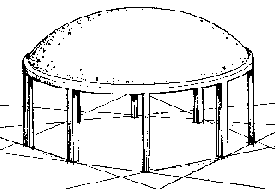
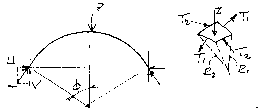
Domes of Revolution
Translation Shells


BARREL SHELLS

First find the longitudinal and shear (diagonal tension) reinforcing required for a typical interior element of the structure.

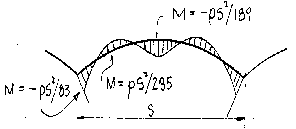
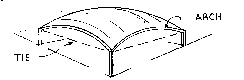
1. A barrel shells acts as a beam in the long direction and as an arch in the curved area. The arch is supported by internal shears. Approximate values for the bending moments in the arch are summarized in the following sketch.

Bending Moments

2. The area of reinforcing is obtained by estimating the effective depth of the beam element, from the center of reinforcing to the center of compression. The force in the reinforcing is equal to the bending moment divided by the effective depth. It may require several approximations to get a fair value. The area of reinforcing is, of course, the force divided by the allowable stress.

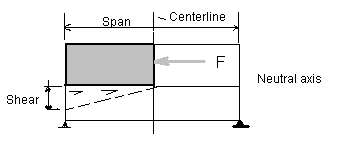
Force
 

3. The tension in the diagonal direction is determined first by equating the longitudinal force to the shear forces.

Shear = F

4. The sum of the shearing forces equals the longitudinal forces. Let S equal the unit shear at the end of the beam. Then: S times the width of the shell times the length divided by 4 equals the longitudinal force.

If there are no other forces on an element at the neutral axis of the beam, then the diagonal tension equals the shear. From this information, a pattern of diagonal tension bars can be constructed.

5. The horizontal reaction of the arch elements of the shell must be contained by an rigid frame and a horizontal tie. Assume that this is simply a wide arch equal to half of the span. An approximation for the horizontal force would be equal to the load per foot on this arch times the arch span, squared divided by 8 and the rise. The thrust in the arch can be determined from this and the vertical reaction.

6. The edge spans of the shell should be supported by intermediate columns. The stiffness of a barrel shell at the outside edges is simply not stiff or strong enough to carry the required loads. The shell reinforcing at the edge members acts more like a typical arch and should be reinforced with two layers of bars.

Return to start of program

Return to types of shells

FOLDED PLATES

The design of folded plate roof structures follows the design of barrel shells, but is much simpler because the elements are all essentially beams.

1. Support the folded plate at its longitudinal edges by frequent columns as was suggested for barrel shells.

2. Analyse and design the slab element as a continuous beam on fixed supports, including the first spans, normally a simple support. If it is haunched, then as a continuous haunched beam.

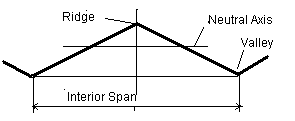
Cross section

3. Design a typical longitudinal interior element as a beam by the usual methods.

4. Support the ends of the folded plates by rigid frames. In this case the frames are loaded by the shear forces from the slab element and are in the plane of the frame members.

Return to start of program
Return to types of shells


UMBRELLA SHELLS

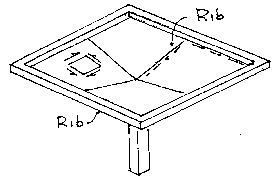
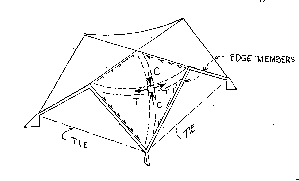
Following is a sketch of a typical inverted umbrella hypar. The principal elements are:

Umbrella shell

Every thing about tunnels

With more than six million kilometers of highways and 240,000 kilometers of railways snaking across the United States, life above ground has become increasingly congested. Tunnels provide some of the last available space for cars and trains, water and sewage, even power and communication lines. Today, it's safe to bore through mountains and burrow beneath oceans -- but it was not always this way. In fact, it took engineers thousands of years to perfect the art of digging tunnels.

Image of a Roman Aqueduct
Ancient Roman aqueduct

_

Before cars and trains, tunnels carried only water.
Roman engineers created the most extensive network of tunnels in the ancient world. They built sloping structures, called aqueducts, to carry water from mountain springs to cities and villages. They carved underground chambers and built elegant arch structures not only to carry fresh water into the city, but to carry wastewater out.


Image of Worsley Underground Canal Tunnel
Worsley Underground
Canal Tunnel

_

By the 17th century, tunnels were being constructed for canals.
Without roads or railways to transport raw materials from the country to the city, watery highways became the best way to haul freight over great distances.


Image of the Holland Tunnel
Holland Tunnel

_

With trains and cars came a tremendous expansion in tunnel construction.During the 19th and 20th centuries, the development of railroad and motor vehicle transportation led to bigger, better, and longer tunnels.


Image of a tunnel boring machine
Tunnel boring machine

_

Today, not even mountains and oceans stand in the way.
With the latest tunnel construction technology, engineers can bore through mountains, under rivers, and beneath bustling cities. Before carving a tunnel, engineers investigate ground conditions by analyzing soil and rock samples and drilling test holes.


There are three steps to a tunnel's success.
Today, engineers know that there are three basic steps to building a stable tunnel. The first step is excavation: engineers dig through the earth with a reliable tool or technique. The second step is support: engineers must support any unstable ground around them while they dig. The final step is lining: engineers add the final touches, like the roadway and lights, when the tunnel is structurally sound.

Based on the setting, tunnels can be divided into three major types:


Image of Brunel's shield
Section of Brunel's
tunnel shield

_

Soft-ground tunnels...
are typically shallow and are often used as subways, water-supply systems, and sewers. Because the ground is soft, a support structure, called a tunnel shield, must be used at the head of the tunnel to prevent it from collapsing.

Check out the forces that act on soft-ground tunnels!


Image of the Hoosac Tunnel
Hoosac Tunnel interior

_

Rock tunnels...
require little or no extra support during construction and are often used as railways or roadways through mountains. Years ago, engineers were forced to blast through mountains with dynamite. Today they rely on enormous rock-chewing contraptions called tunnel boring machines.

Ted Williams Tunnel

Tunnel segment,
Boston Harbor


_
Underwater tunnels...
are particularly tricky to construct, as water must be held back while the tunnel is being built. Early engineers used pressurized excavation chambers to prevent water from gushing into tunnels. Today, prefabricated tunnel segments can be floated into position, sunk, and attached to other sections.


مثالی از آنالیز یک قاب توسط نرم افزار SAP

آنالیز یک قالب با نرم افزار سپ (450 کلیوبایت)


آناليز دال بتني مستطيلي با تئوري جاري شدن خطي


آناليز دال بتني مستطيلي با تئوري جاري شدن خطي(۱۰۰ كيلوبايت)(لاتين)